How We Keep Worldschooling Affordable as a Family of Five
Preston Clark
·
·
11
min read
·
Central America and Mexico

Written for
World travel families
The biggest thing we do to keep worldschooling affordable is live a normal life wherever we are. We stay at least a month, look for housing locally, eat what is available locally, and do our own homeschooling. We go hiking, walking and exploring. We spend time getting to know people.
When we first started looking into worldschooling, we kept finding hubs and organized trips. Some families spend a summer at a hub. Others move from one to another. We have met families who enjoy that and have the budget for it.
But we were surprised at what some of those programs cost. We wanted to understand how to travel abroad with our three children, keep their education going, and make it affordable for a longer period.
We had to figure a lot of that out by reading between the lines and then experiencing it ourselves. Here is how we do it.
What we have spent, and what we are planning for
We have gone through every credit card, debit card and cash withdrawal since we left Texas on May 24, 2026. Our travel and living costs through October 15 total $16,184.51, with the bills for our current stay already paid. The total spent is confirmed. Some of the cash-category breakdowns are approximate.
The initial drive from Texas to Roatán was by far our most expensive move. Fuel, food, hotels, border crossings and the ferry added up. It was still significantly cheaper for our family than flying there and paying for transportation afterward, but it was pricey.
The one move we have made since then, from Roatán to Guatemala, was much cheaper, even with another international border crossing. Our next move is smaller again: roughly ten hours of driving to San Cristóbal, which we expect to take one to one and a half days.
Looking ahead and based on where our costs are trending, we estimate $30,000 a year, or $2,500 a month, for our family’s living costs and travel within the region. That projection includes moving between places as we generally stay one or two months at each stop. Our recent spending and shorter planned moves are the basis for that annual budget.
Both figures cover our life and travel abroad. Ongoing American obligations, unrelated U.S. subscriptions and some education purchases reimbursed separately are outside these figures. We have reduced our American costs considerably, but we still have things such as life insurance. Those need to be added when you put together your own family’s budget.
All dollar figures here are in U.S. dollars.
Stay long enough to get a monthly rate
We generally stay one or two months in a place. That lets us look for monthly rent instead of paying a nightly rate throughout the stay.
Roatán was originally meant to be a three-month trial. During that stay, we learned that keeping stays shorter worked better for our son’s needs. Longer stays would spread the moving costs over more time, but we are choosing a rhythm that fits our family.
Our Roatán rental was $750 a month before utilities. Our Guatemala home is $700 a month. We also found smaller homes here that would have fit our family for closer to $500.
Our next place, already booked in San Cristóbal, Mexico, is $580 a month including utilities. We found it by using ChatGPT to search listings in the area, and it was actually toward the upper end of the inexpensive options we found there. That is a booked price for an upcoming stay.
The key is to search locally. Look for the places people in that area use to find housing.
In Roatán, we watched local Facebook rental groups and found numerous homes under $1,000 a month. We have also learned to ask local congregation leaders in the LDS Church. They have been helpful in finding places.
Some families get a hotel or Airbnb for a few days and look around after arriving. That is a reasonable option too. Since being here, we have found multiple places we did not know about before we arrived.
Those are our rentals and our experience searching. The prices will depend on where you go, but looking locally and staying longer have made a big difference for us.
Check utilities as carefully as rent
Our $750 Roatán rent did not include utilities. The owners told us those would usually range from $300 to $500 a month, depending on how much we used the AC.
We thought we were being extra careful by keeping the AC at 28°C during the day and 23°C at night. But two things ended up costing us.
The first was a malfunction. The AC compressor kept running even when the indoor head unit was off. It ran around the clock for about two weeks before we caught it. The owners got it fixed, but we still had to pay for the power.
The second was the way we were using the AC. Back in Utah, I had always been told it was cheaper to maintain a cool temperature than to let a home heat up and cool it down again. We brought that assumption with us.
Our rental had much less insulation than we were used to. Toward the end of our stay, a local recommended turning the AC off when we went out for the day and cooling the house when we returned. Unfortunately, we learned that too late to change much of our bill.
Between the malfunction and how we were running the AC, we estimate we spent about $1,000 extra. That expense is already included in our spending total.
Ask how people normally cool that particular home, what they do when they go out, and what their utility bills look like. Also check that the AC is shutting down properly. Those are things we wish we had checked earlier.
Shop and eat locally
We eat what is available where we are. Chicken, pork, rice, beans and local vegetables make up a lot of our meals.
We do not try to keep buying imported American food. From what we have seen, that gets expensive pretty quickly.
Our diet has changed as we have traveled. Part of that is wanting to live like the people around us, and part is keeping our grocery costs down. We still eat out, but normal grocery shopping and cooking are a big part of our routine.
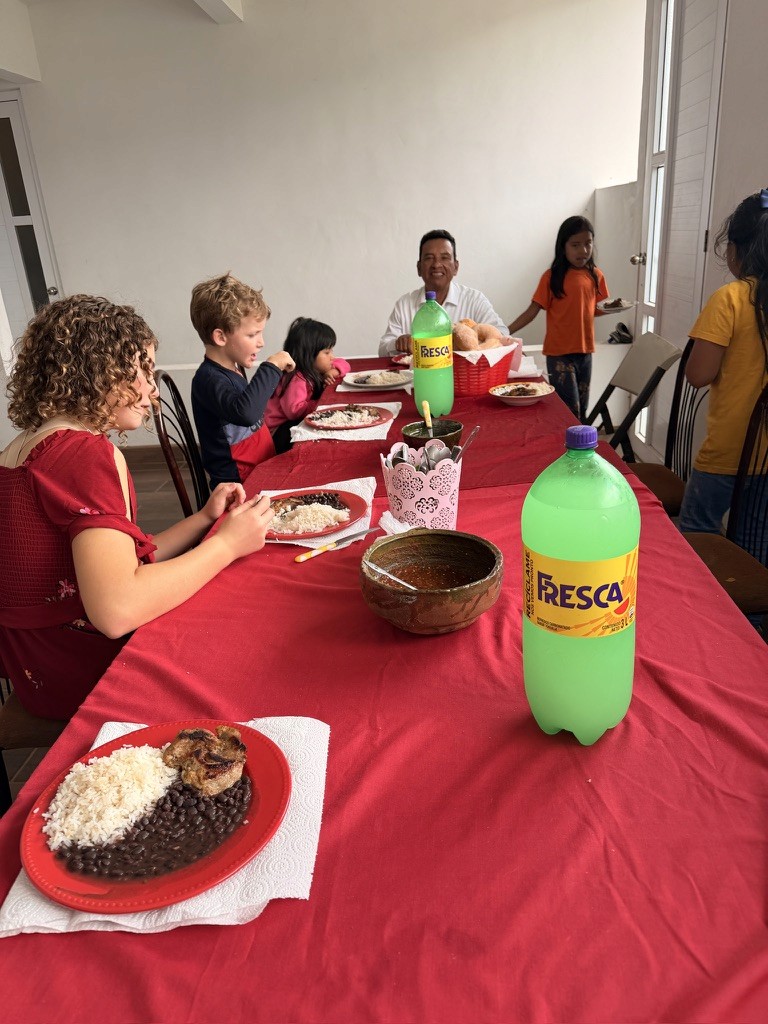
Sharing a meal around the table.
Do your own homeschooling
We do our own homeschooling. My wife describes our approach as more of a classical Charlotte Mason approach.
We have daily lessons, math supplements, individual reading, family read-alouds and reading time at night. We also have devotional time. History, culture and exploring become part of our weekly activities.
One of our math curriculum subscriptions is about $25 a year. We also use Kobo, Audible and Charlotte Mason resources. Some of our materials were purchased before this trip, and we have continued using them.
If your home state offers an education funding or reimbursement program, check which expenses it covers and whether your travel plans meet its residency requirements. Ask the program directly how it treats temporary travel, including time abroad, before counting on reimbursement in your budget.
For your own budget, price the books, curriculum, apps and supplies you plan to use. Include what you already have and any reimbursement available to your family.
The hubs we first found offered a different way to organize worldschooling. We have chosen to put together our own school routine and find learning opportunities where we live.
Get to know people and learn with them
The local learning has been a huge part of this for us.
In Guatemala, we made friends with a family who run a small farm. They sell produce and raise chickens. The children have been learning Spanish, harvesting onions and beans, grafting, and cooking with traditional Mayan Guatemalan methods and recipes.

Food prepared over a wood-fired stove.
Our weekly sessions have been about three to four hours for our three children and my wife. I sometimes go too. Our arrangement has involved buying vegetables from them at a higher-than-normal price, with about 35 quetzals, roughly $5, spent for a session for the group.
Other women have shared skills such as preparing a chicken, growing mushrooms, weaving and dressmaking. The children also play soccer.
In Punta Gorda, the Garifuna village we visited in Roatán, we made friends with a woman who taught my wife and daughter how to braid and braided my daughter’s hair. They were there for hours. My recollection is that it was around $10 or $20.
These opportunities have come from getting to know people and asking about what they do. Some have shown us things freely. Other times we pay or buy something from them.
We have built good, dear and deep friendships. The learning has come through those relationships, and when we pay for someone’s time or buy what they make or grow, that money goes directly to them.
Spend time outside the busiest tourist areas
In Roatán, we stayed on the east end of the island, away from the busiest areas we saw for tourism and expats. It was less expensive for us, and we had more opportunities to get to know the people living there.
We have found a similar pattern in Guatemala. We still visit places such as Antigua, which is beautiful. In the busiest visitor areas, though, we have experienced more sales approaches and higher starting prices.
In the smaller communities where we have spent time, we have felt much less pressure to buy things. We have had time to talk, make friends and learn about the place through those friendships.
For us, where we stay changes both what we spend and how we experience a place.
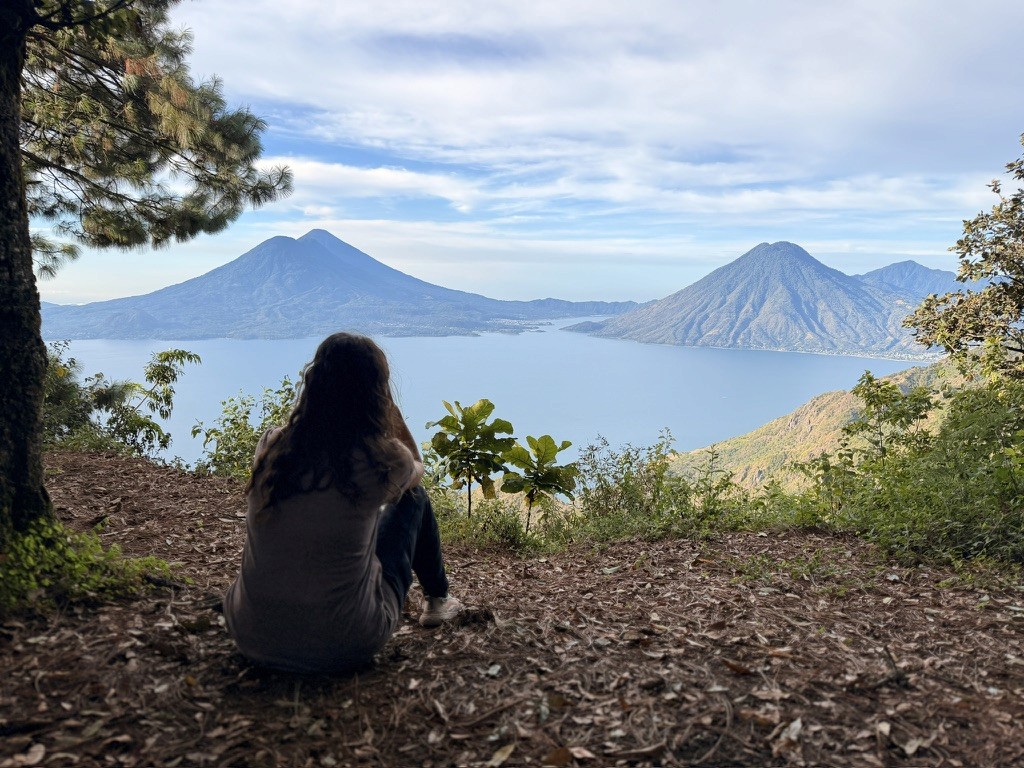
Taking time to enjoy the view.
Choose ordinary outings and slower moves
Most of our outings are walking, hiking, exploring, learning history and visiting museums. We generally do not pay for lots of organized excursions.
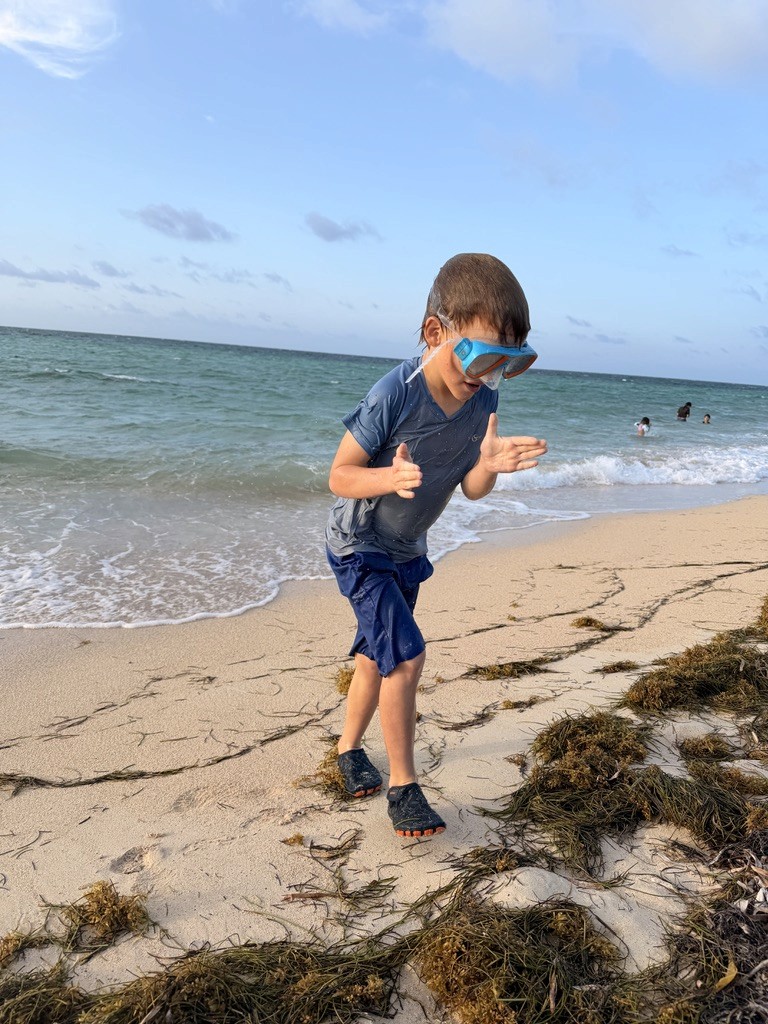
Time at the beach.
When you stay somewhere long enough, you start learning how the people who live there enjoy it. Sometimes an experience that first looked expensive has a much simpler way to do it.
Moving is another part of the budget we pay attention to. Our first trip from Texas to Roatán cost $2,376.75. Our next move, from Roatán to Guatemala, cost $1,082.44, about 54% less.
Taking the car to the island and back was expensive. Now we are planning shorter moves within the region. The upcoming drive to San Cristóbal is roughly ten hours, and we expect the move to take one to one and a half days.

A stop along the way.
A family needs money to get there and get established, whether they fly or drive. Then they need a budget for ordinary living and later moves. Staying longer helps spread those moving costs over more time.
We have our own car, and it is paid off. For our family of five and a dog, keeping the car has been the cheaper option in our comparisons with rental vehicles and public transportation. Even the more expensive drive to Roatán worked out cheaper for us than flying the family there and paying for transportation afterward.
We have no monthly car payment, insurance has been fairly inexpensive for us, and our fuel spending has been manageable with shorter regional moves. Fuel per gallon can be expensive, but we are generally covering shorter distances now.
Fuel, insurance and maintenance still belong in the budget. Another family’s comparison will depend on the number of people traveling, the length of each stay and how often they need transportation. Price the whole route and normal weekly travel when choosing between a car, rentals and public transportation.
Account for work and the expenses that come with your family
I work in remote sales as an independent contractor for a data-as-a-service company and a SaaS company. I get paid commissions on what we land.
This was something I had never done before. I was used to blue-collar work, but in the situation I found myself in, I had to learn to do something different.
We also have some income from a rental house. In slower months, we draw from savings. Having a little savings helps when the income is uneven.
Our income needs have gone down considerably from our upper-middle-class American lifestyle. Even living in an RV in the United States, at around $5,000 a month for us in many places, was a considerable savings. Our experience living abroad has been less expensive again.
Reliable internet matters for my work. We carry a mini Starlink for times when the local internet is not good enough, and trip-use Starlink charges are included in our travel budget.
We also travel with a dog. The paperwork needed for our border crossings has added costs of $50, $150 and $200 at different stages of the trip. Those are border-crossing expenses for traveling with the dog, separate from everyday dog food and care.
The Guatemala arrangement was more expensive partly because the vet had to travel to Guatemala City to handle the paperwork. We chose to have him take care of that instead of doing the long round trip ourselves.
Dog food is roughly $20 to $30 a month for us. Your family’s extra costs may be different, but they still belong in the budget.
What the lower costs give us
One of the positives we see in this lifestyle is the opportunity to spend less time working when we can. That does not happen every month. But keeping our income needs lower gives us more room to make that choice.
We still have normal schedules. We work, homeschool, shop, cook and spend time together. We just do those things in different places.

Time to play outside.
Staying longer, searching locally, eating locally and arranging our own learning have made this more affordable for us. They have also let us enjoy places slower and more thoroughly. Those are the choices behind our budget.
Related posts


Get new posts by email, a few times a month, nothing else.
May there be a road.