New vs Used RV: Depreciation & 5-Year Cost Truth
Preston Clark
·
·
5
min read
·

Written for
RV families
After more than fifteen years around automotive and equipment valuation, watching trucks, trailers, and heavy assets lose value the moment paperwork is signed, and after owning multiple RVs ourselves, one pattern has stayed consistent, depreciation doesn’t care how excited you are. For most families, buying a new RV is one of the worst financial decisions they can make, because depreciation is real. That’s just math.
The structural difference between the two is straightforward. A new RV carries the highest purchase price, the largest depreciation hit in the first five years, a full factory warranty, higher taxes and insurance, and a higher chance of ending up underwater if you finance it. A used RV, five years or older, costs much less to start, has already absorbed most of its early depreciation, usually carries limited or optional extended warranty coverage, costs less in taxes and insurance, and gives you an easier exit if your plans change.
The Depreciation Reality Most Buyers Underestimate
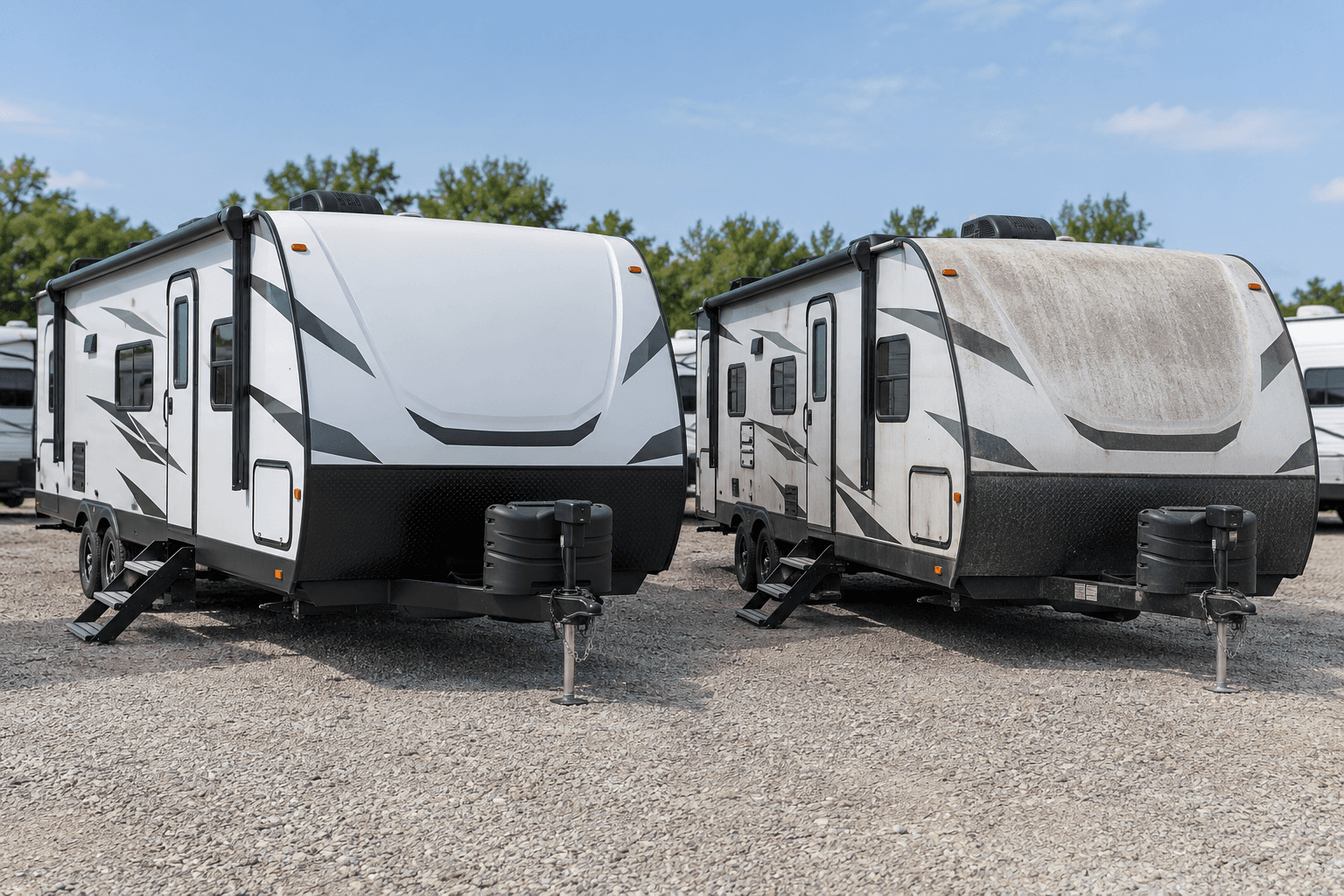
New RVs commonly lose 15 to 25 percent in the first year, and some classes lose close to a third of their value within just a few years. On a $150,000 rig, that’s $22,500 to $37,500 gone in twelve months. By year five, many $150,000 units are trading between $55,000 and $75,000 depending on condition and timing, which works out to $75,000 to $95,000 in depreciation. Industry valuation data from J.D. Power RV values shows how steep early depreciation can be across most classes.
If you purchased during the 2020 to 2022 surge, the correction has been sharper. As of 2026, dealer inventories have normalized and used supply is strong in many regions. Shipment data from the RV Industry Association reflects how production surged and then corrected after the pandemic boom. That shift has returned leverage to buyers. After year five, depreciation slows significantly.
A Realistic Five-Year Comparison
These are example ranges, not lender quotes. Class, state taxes, usage, and financing terms will change the numbers. A new $150,000 RV commonly loses $22,500 to $37,500 in year one alone and $75,000 to $95,000 over five years, versus $10,000 to $30,000 for a used RV in the $40,000 to $70,000 range over the same stretch. Sales tax on the new unit runs $7,000 to $15,000 against $2,000 to $7,000 on the used one. Five-year insurance runs higher on the new rig. For a fully amortizing loan at a fixed 8 percent, paid monthly over 15 years with no fees or early payoff, a $100,000 loan means about $36,100 in interest during the first five years, versus about $14,400 on a $40,000 loan. Over the full 15 years, the interest totals are about $72,000 and $28,800.
Many new RVs now include lithium battery systems, factory solar prep, upgraded inverters, and integrated control panels. A five to seven year old rig may require a $3,000 to $5,000 lithium and solar retrofit to match that off-grid capability for typical boondocking needs. Even factoring that in, the depreciation gap between new and used typically dwarfs the upgrade cost.
When you calculate the true total cost of ownership, depreciation, interest, taxes, insurance, and upgrade costs all matter. Compare them over the same time period. If you want a deeper breakdown on timing the depreciation curve, read our guide on the best age to buy a used RV. That’s money you could put toward retirement.
Total Cost of Ownership Is Bigger Than the Sticker
Besides depreciation, taxes go up with the price, insurance with the value, and registration often with MSRP. Financing adds more cost. If depreciation outpaces principal reduction, you’re underwater, and if life changes and you need to sell, you write a check to exit. The monthly payment doesn’t tell you what the RV will cost you overall.
Our Experience Buying New
Our first RV was brand new. Within months we dealt with air conditioning failure, water pump issues, and repeated warranty visits. That unit spent nearly five months at a dealership in its first year. Warranty covered parts, but we lost that time.
Since then, we have owned seven used RVs, and we’ve learned quickly that reliability and depreciation aren’t the same thing. The early defects were already surfaced. The steep depreciation was already absorbed. Our exit losses were minimal or nonexistent. Buying used means stepping in after someone else absorbed the steepest financial drop.
What About Warranties and Lemon Laws?
New RVs come with factory warranties. In most states, lemon law protections apply primarily to new motor vehicles, and RV coverage can vary by state. For reference, the Federal Trade Commission publishes general consumer protection guidance. For some buyers, that peace of mind matters, but it comes at a financial premium. Extended warranties exist for used RVs. They’re not perfect, but warranty coverage alone rarely justifies absorbing $75,000 to $95,000 in depreciation.
The Sweet Spot: Five to Ten Years Old
For most families comparing new versus used, the strongest financial position is five to ten years old. The steepest depreciation is behind you, major factory defects have surfaced, layouts still feel modern, and annual value loss slows. Past ten years, cosmetic wear increases and some parks enforce appearance standards. If you’re traveling full-time or homeschooling on the road, condition and livability matter. But financially, five to ten years is disciplined asset timing.
The Used RV Safety Net: Professional Inspections
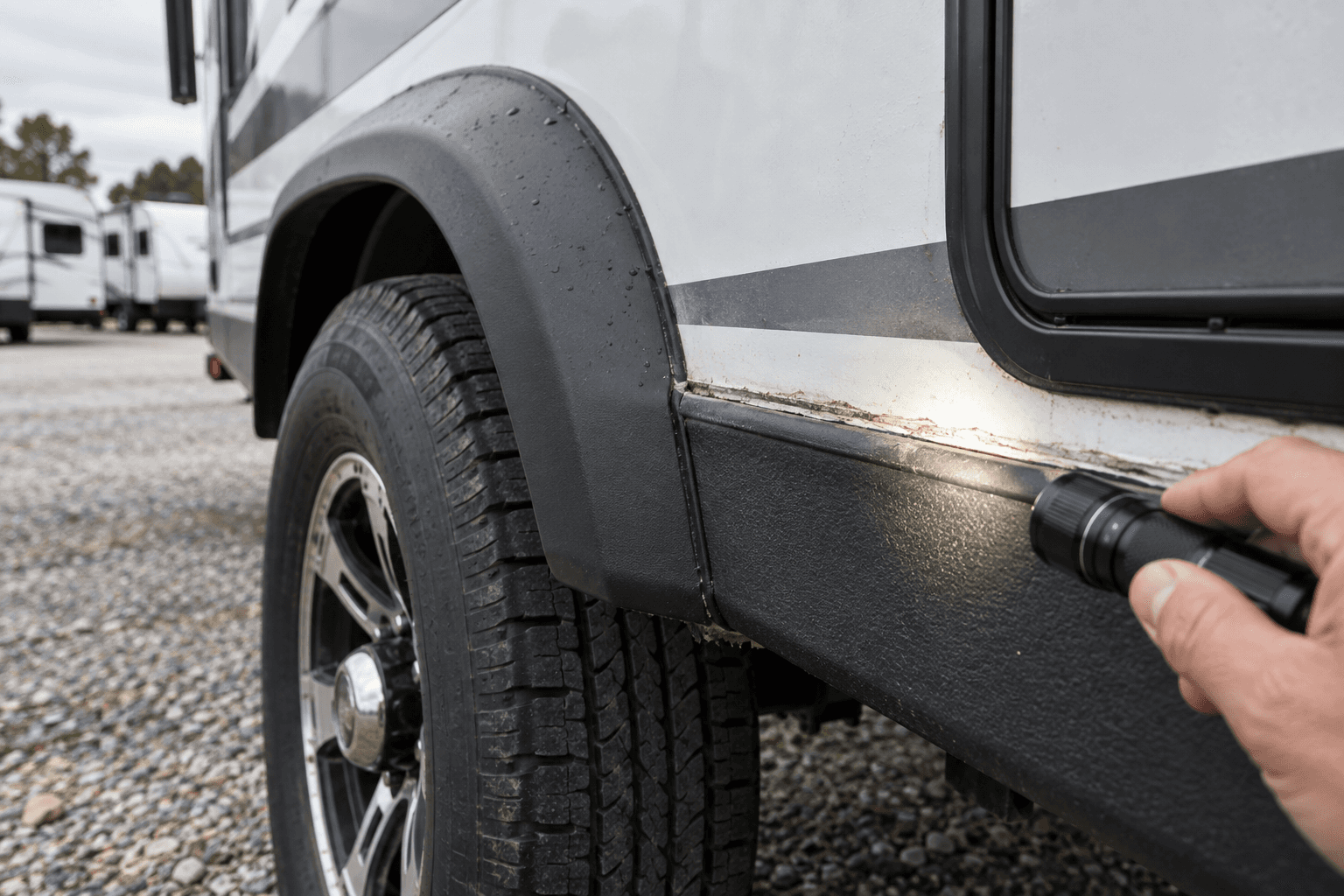
Condition is everything. If you’re not confident evaluating a rig yourself, hire a certified RV inspector. Professional inspections typically cost between $500 and $1,000 depending on size, and that inspection is your real-world insurance policy against buying a hidden project. Spending $800 to confirm condition is minor compared to losing $40,000 in first-year depreciation on a new one.
Maintenance Reality
RVs require maintenance regardless of age. We budget $200 to $300 per month for the RV itself. In 13 months full-time, we replaced an axle, multiple tires, water pumps, roof sealant, plumbing fixtures, and a door lock. Wear items hit new rigs too. Tires, sealant, and pumps don’t care about model year. The difference is whether you’re absorbing small repair bills on a depreciated asset or losing massive value up front.
Is It Better to Buy New or Used?
For most families, buying used is financially superior. If you must finance, buying new multiplies both depreciation and interest. If the RV represents a large percentage of your net worth, buying new increases risk. If you can comfortably pay cash and depreciation doesn’t affect long-term financial stability, buying new becomes preference. That situation is rare.
Frequently Asked Questions
Do used RVs break more? No. Many major defects show up in the first year of ownership and are already repaired by the time a rig reaches five years old.
How much value does an RV lose each year? Many RVs lose around 15 to 25 percent in the first year and another 10 to 15 percent annually through years two to five. After year five, depreciation typically slows.
Can you finance a used RV? Yes. Rates are often similar to new RV loans, but your total exposure is lower because the purchase price is lower.
Is buying new ever worth it? If you can pay cash and the purchase represents a small portion of your net worth, it can make sense. For most families, it doesn’t.
The Bigger Financial Picture
Depreciation and interest are where we’ve seen people lose the most money. If instead of losing $30,000 to $90,000 every few years you invested even a portion of that consistently, the long-term impact over decades could be dramatic. Before committing to a long loan term, it’s worth asking whether you should finance an RV at all.
New smell and updated cabinetry aren’t worth what they cost you.
If you have to finance, buy used. If the RV would be a big share of your net worth, buy used. If you can pay cash and depreciation doesn’t change anything for you, new is just a preference.
Related posts


Get new posts by email, a few times a month, nothing else.
May there be a road.