Best RV Washer and Dryer for Full Time Living: What Works
Preston Clark
·
·
11
min read
·

Written for
RV families
Laundry is one of those things nobody talks about when they’re dreaming up life on the road, and one of the first things that becomes a real logistical problem once you’re actually living it. We’re a family of five. Our kids are outside every day, often dirty, and because of our son’s needs, we go through more laundry than the average RV family. So this isn’t a theoretical conversation for us. Over the past year and a half on the road, we have owned and used three different washer and dryer setups, tested and evaluated several more, and talked at length with other full-timers who have direct experience with units we haven’t personally owned. Below is what the options are, which ones we’d buy, and which ones we’d leave on the shelf.
Start Here: Which Category Are You?
Before you look at a single model or price, you need to know what your rig will actually accommodate. This determines your options more than anything else, and skipping this step is how people end up buying a unit that physically won’t fit or doesn’t have the power requirements their setup can support.
If you have one small cabinet, a single dedicated opening designed for a compact all-in-one unit, you’re in Category 1. If you have two separate openings, stacked or side by side, sized for RV-specific units, you’re in Category 2. And if you have an open garage or large utility space, a toy hauler or larger fifth wheel with room for a full-size residential unit, you’re in Category 3.
One constraint regardless of which category applies to you is that every RV washer and dryer option we’re covering here runs on 110V. Most rigs don’t have the 240V service that a standard residential washer and dryer would need. The units we recommend are all designed around that limitation, and it’s worth confirming your rig’s electrical setup before you start shopping.
Before You Shop: The Vented vs. Ventless Decision
For us, vented is better if you can swing it. Clothes come out dry, cycle times are reasonable, technology is simple and proven. If your rig has a vent or you can add one, do it. Some people assume they can’t add a vent if one wasn’t factory installed, but plenty of full-timers have drilled one in and made it work. It’s worth exploring before you default to ventless.
Ventless condensing is a category we’d avoid. This is the majority of compact RV all-in-ones on the market. Dry times are long, clothes often come out still damp, and the ratings across nearly every brand in this category reflect that. We wouldn’t recommend a ventless condensing unit to anyone who has another option.
Ventless heat pump is the exception. Heat pump dryer technology is different from condensing. A good ventless heat pump unit dries considerably better, with performance that gets reasonably close to a vented dryer. It’s close enough that it becomes a legitimate option, particularly for full-timers with a larger rig who want the flexibility of not needing an external vent. The catch is that heat pump technology currently only exists in the larger residential-sized all-in-ones. If you’re in the small RV cabinet category, your ventless options are all condensers, which is exactly why we push so hard toward vented in that size class.
We’d choose vented if we could. If you can’t vent, we’d only consider a heat pump unit. The other ventless options are condensers, and we wouldn’t recommend them.
Category 1: RV-Sized All-in-Ones
For rigs with a single small cabinet, these are the compact combo units designed specifically for that space. They wash and dry in the same drum, which means no switching loads, and they’re built to fit within the footprint most rigs allow. Capacity is roughly 1.9 to 2.0 cubic feet, enough for a queen-sized blanket or about half of a standard hanging laundry bag per load. That’s not a lot, but it’s workable.
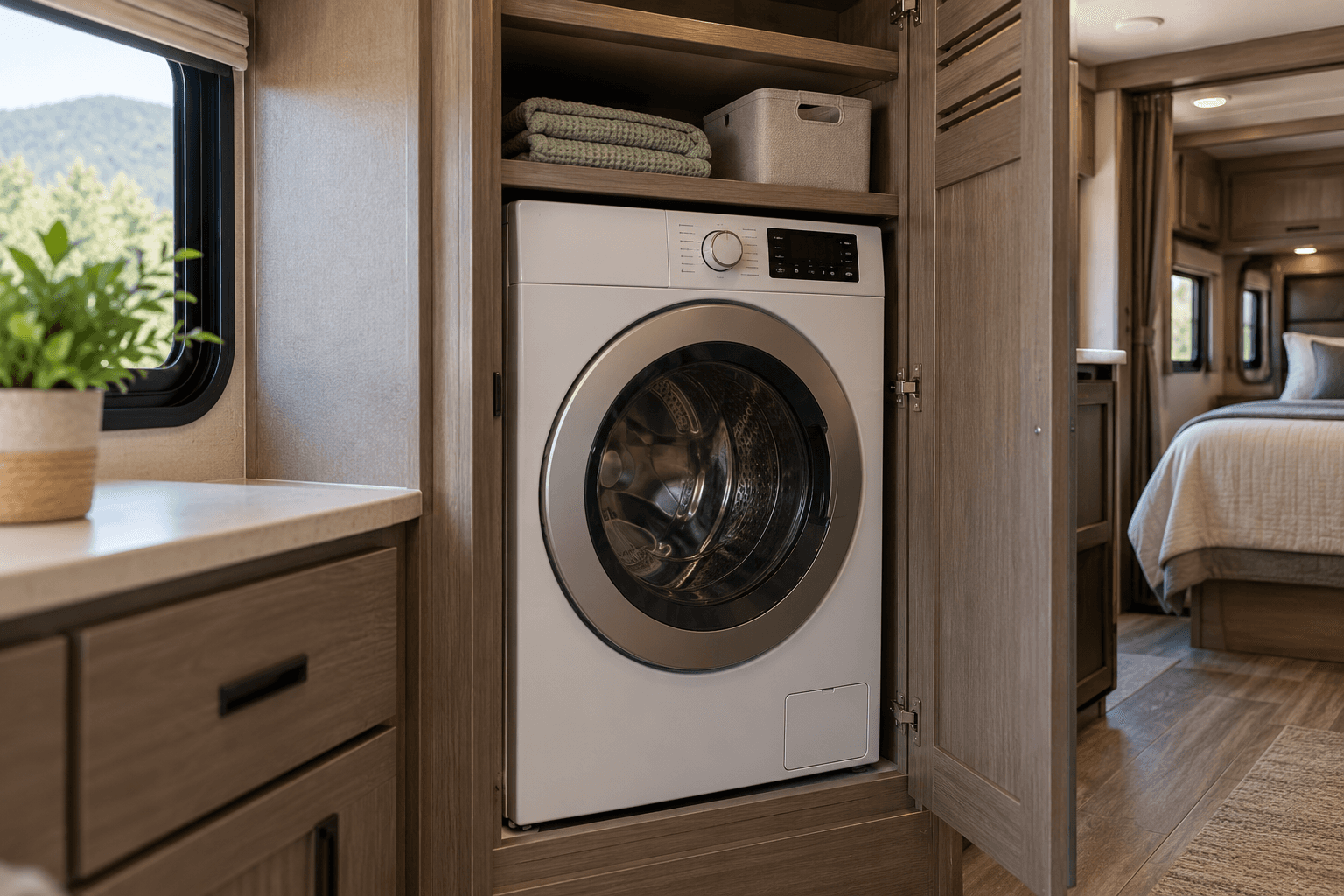
Our top pick is the Splendide WDV2200XCD, running around $1,300 to $1,500 new. Splendide is the dominant name in this category, and for good reason. They build specifically for the RV market, which means marine-grade construction, simple controls, and a reliability track record that holds up across years of full-time use. We have owned two Splendide units, our first setup on the road and our current one, and both have performed consistently without drama. The WDV2200XCD is vented, which as we covered already makes a meaningful difference in how well your clothes come out dry. Maintenance is straightforward; Splendide recommends cleaning the lint from the exhaust and the drain trap roughly once a quarter, and in our experience that holds true. Cycle times are reasonable, build quality is solid, and when something goes wrong parts are available.
Also worth considering is the older Splendide WD2100XC in the same vented line, which uses electromechanical controls rather than digital ones. Some people prefer that for simplicity and durability. Performance is comparable, and if you find one used and well cared for, it’s a reliable option.
We’d skip the Splendide WDC7200XCD, the ventless condensing version, since the vented model performs better for the same price range. We’d also skip the Equator EZ 4800 V; it’s vented and functions fine, but build quality and long-term parts availability don’t match the Splendide, and for a similar price the Splendide is simply more proven. And we’d skip the Contoure RV-WD900, a 2.7 cubic foot ventless combo sold exclusively through Camping World, since it’s a condensing unit that shows the same weak reviews we see across every compact ventless condenser on the market.
Category 2: RV-Sized Separate Units
If your rig has two smaller openings rather than one, you have the option to run a dedicated RV-sized washer and a separate RV-sized dryer. This is the setup we started with, and looking back, it was better than we gave it credit for at the time. We got rid of it because we wanted to save space and time from having to switch laundry from the washer to the dryer.
The washer capacity is similar to the all-in-one, both sit around 1.9 cubic feet. The real advantage here is throughput. With a separate washer and dryer running simultaneously, you can move through laundry at roughly twice the pace of a combo unit. For a larger family that’s a practical difference.
Our top pick is the Splendide WFL1300XD washer paired with the DV6500X dryer, around $2,100 new for the pair. The DV6500X is the current vented stackable dryer in Splendide’s lineup; you’ll occasionally still see the older TVM63X referenced, but the DV6500X is what’s actively available now. It’s the same simple Splendide build as the Category 1 unit, and it holds up the same way full time. The main practical advantage here over an all-in-one is that you can have one load drying while the next load is washing. For larger families or anyone who does laundry in bigger batches, that adds up. The trade-off is that you have to physically switch loads, which sounds minor until you’re living in a smaller space and doing it regularly. Some people don’t mind switching loads. Others would rather load once and walk away.
We’d skip the Equator 826 washer paired with the 852 dryer, since that dryer is ventless and condensing, the same category we already steered away from.
Category 3: Residential-Sized 110V All-in-Ones
If you have a toy hauler or a larger rig with enough open space to fit a full-size unit, you have access to a different class of washer and dryer entirely. These are residential-grade all-in-ones, 4.6 to 5.3 cubic feet, significantly larger than anything in the RV-specific categories, and they all run on 110V. The trade-off is that they require more space, they’re more expensive, and as we learned firsthand, they demand more maintenance.
In this category we’d only look at vented units or ventless with a heat pump. A condenser this size isn’t worth the frustration.
A note on weight before you decide: these are heavy machines. The LG WashCombo is the lightest of the group at around 247 lbs. The GE Profile comes in at 302 lbs, and the Samsung Bespoke runs in a similar range. Make sure you have a realistic plan for getting it in and out of your rig, it’s a project. And that weight is permanent payload on your RV, which matters if you’re watching your gross vehicle weight rating closely.
The best unit in this entire category, if your setup can accommodate a vent, is the Samsung Bespoke Vented All-in-One (5.3 cu ft). A vented all-in-one at residential capacity performs the closest to what you had at home, faster dry times, clothes that come out dry, and none of the heat pump trade-offs.
For everyone else, three ventless heat pump units are all worth recommending, and the honest answer is that the right one comes down to brand preference more than a clear performance gap. All three run on 110V, all three use heat pump technology, and all three are rated well enough that we feel comfortable recommending them. The LG 5.0 cu ft WashCombo is the unit we owned and have the most direct experience with. We had it for about eight months before it failed, and it took nearly five months of warranty work to get resolved, ultimately LG bought it back. The failure turned out to be the power button, which is almost funny in retrospect, but the repair process was a real ordeal. Every technician who touched it complained about working on all-in-one systems. To be fair, the unit itself performed well while it ran. Cycle times were around two and a half to three hours for a full load, which sounds long but produces a large basket of clean, dry clothes. LG’s warranty did ultimately make it right, and we’d still consider it again with clearer eyes about the maintenance demands. The Samsung Bespoke Ventless Heat Pump (5.3 cu ft) is the ventless version of our top pick, carrying the same strong reputation, worth choosing if you want the Samsung build and features but can’t run a vent. And the GE Profile UltraFast (4.6 cu ft) is a unit we tested and evaluated seriously before going with the LG. It’s a well-built machine and a legitimate choice.
We’d skip the LG 2.4 cu ft all-in-one and the GE 2.4 cu ft combo, since both are ventless condensing systems, and at this price point there’s no reason to accept condenser drying performance when better options exist for comparable money. Same with the LG 24-inch Washtower, which has the same ventless condensing dryer issue.
Maintenance Reality
Maintenance is what you’ll actually deal with once you live with one of these full time.
Splendide units, both the all-in-ones and the separate machines, are built simply and they stay simple to maintain. The vented all-in-one requires cleaning the lint from the exhaust and the drain trap roughly once a quarter, with no sensors to calibrate or complex internal systems to monitor. You learn the cycle times, you run the machine, you clean it quarterly. Because Splendide doesn’t use sensors to detect dryness, everything runs on a timer. It takes a load or two to dial in the right duration, and once you have it, it stays consistent.
All-in-one units, particularly the residential-sized heat pump models, are a different story. They do more, and they require more in return. On our LG, we had three maintenance points that needed to be hit often: cleaning the drain trap roughly every five to ten loads, cleaning the condenser fins every five to ten loads (originally with a toothbrush and a screwdriver, though the design has since been updated so a screwdriver isn’t needed), and cleaning the lint trap after each load, which is normal for every dryer except, apparently, the Splendides.
If you neglect any one of these, wash and dry performance will degrade quickly. Dry times would creep from the expected two to three hours up to five, six, seven hours or more if we let it go. Once we understood the maintenance schedule, it was manageable. But we didn’t understand it at first, and the machine seemed like it was failing when really it just needed to be cleaned. It’s the nature of combining washing and drying in one drum with ventless technology. The Samsung and GE units have made improvements in lint management and condenser cleaning, and some have auto-cleaning condenser systems that help. But the maintenance demand is higher across the board compared to vented separate units, and that’s worth knowing before you commit.
New vs. Used, Where to Find Deals and What to Trust
None of these units are cheap at retail. RV-sized Splendide all-in-ones run $1,300 to $1,500 new. The separate Splendide washer and dryer pair comes in around $2,100. The residential-sized LG, Samsung, and GE units range from $2,000 to $3,000 depending on the model and where you buy. That’s real money, and the good news is there’s almost no reason to pay full price. If you’re still working through the broader question of how to approach a used purchase, our thinking on buying new versus used and on the best age to buy a used RV covers that in more depth.
We’ve never paid retail for any of the units we have owned. Our first Splendide set we found nearly new on Facebook Marketplace at a significant discount. The LG we sourced as a floor demo unit still under warranty for just under $1,000. Our current Splendide all-in-one came from original owners who had barely used it, we paid around $600, less than half of what it would have cost new. Marketplace deals exist across all of these categories if you’re patient and know what you’re looking for.
The confidence level for buying used varies by brand and type. Splendide units are the ones we’d buy used without much hesitation. They’re built simply, they’re durable, and because they don’t rely heavily on electronic sensors or complex internal systems, there’s less to go wrong quietly before a sale. If you can confirm it runs and the drain trap is clean, you’re in good shape.
With the residential all-in-ones, LG, Samsung, GE, we’d be more careful. These are more complex machines, maintenance history matters more, and the things that go wrong are harder and more expensive to fix. A unit that has been poorly maintained or inconsistently cleaned will show it over time, and not always obviously at first. If you go used on one of these, ask specifically about how often the drain trap and condenser were cleaned and whether it has ever had service work done. Equator and lesser-known brands we’d approach with caution used; parts availability is more limited, and support is harder to come by if something goes sideways.
What We’d Buy
If you’re researching the best RV washer and dryer for full time living, the answer depends on your rig.
If you have a single small cabinet, get the Splendide WDV2200XCD. It’s vented, reliable, and about as low maintenance as these get, and it’s the most proven unit in its class. If you can’t run a vent and are stuck with ventless, save your money and wait until you can, a ventless condenser in this size class isn’t worth it.
If you have two separate openings and want to maximize throughput, the Splendide WFL1300XD and DV6500X is the setup we’d go back to. We didn’t appreciate it enough when we had it. Simple, reliable, and the ability to wash and dry simultaneously matters more than we realized at the time.
If you have a toy hauler or open space and want a residential unit, the Samsung Bespoke vented is the one we’d buy if the vent is an option. If it’s not, any of the three heat pump ventless units, LG, Samsung Bespoke ventless, or GE Profile, are legitimate choices. We have the most direct experience with the LG, and we’d buy it again knowing what we know now about the maintenance demands.
What we’re currently running is the Splendide WDV2200XCD all-in-one vented, and for where we are right now it’s the right unit. It does what it needs to do, and after everything we’ve been through with laundry on the road, we like how simple it is.
Related posts


Get new posts by email, a few times a month, nothing else.
May there be a road.